 Lakeland Golf Cart Repair
 Mobile Golf Cart Repair in Lakeland
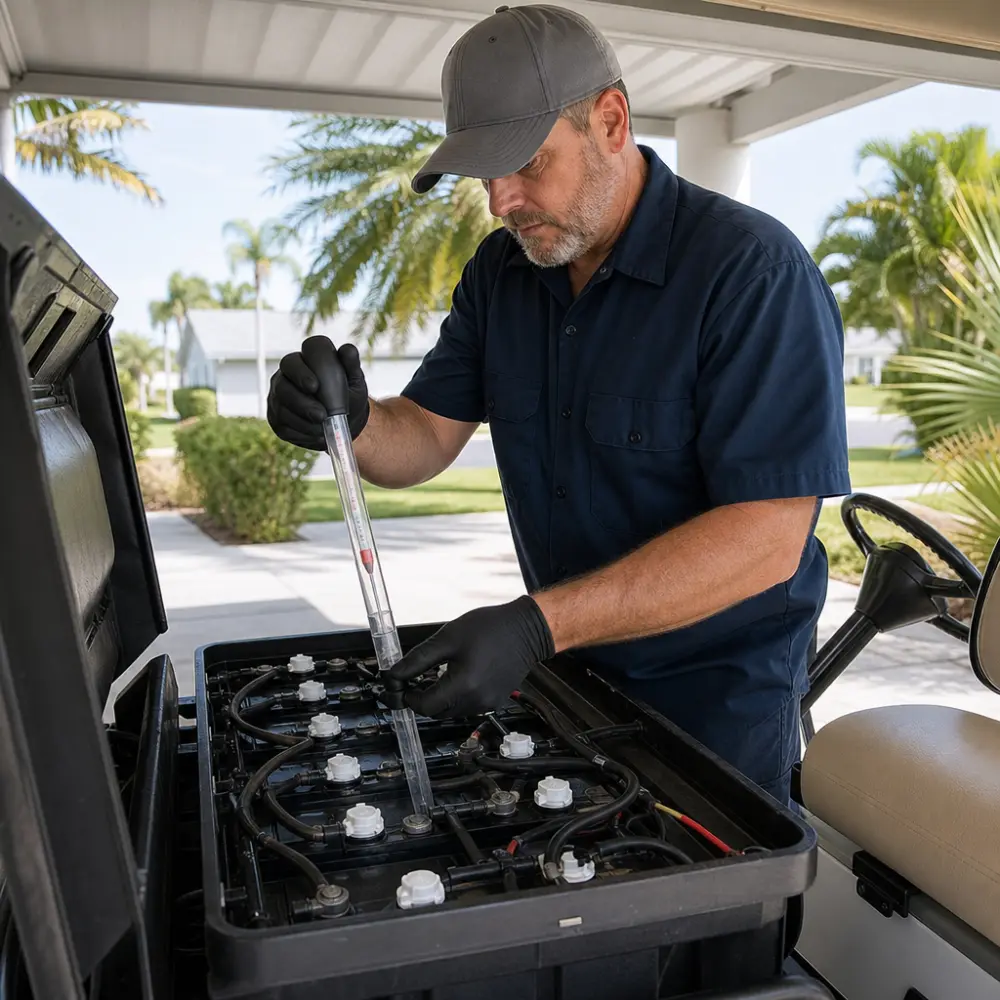
Off US 98 South, Sanlan RV & Golf Resort runs a cart rental fleet of its own for guests who want one on its adjoining 27-hole course, a clear signal that across a resort built on roughly 785 acres, a golf cart is daily equipment rather than an occasional toy. That is true well beyond Sanlan’s fence line: nobody wants to hunt down a trailer, a hitch, and a friend with a truck to get a dead cart somewhere, and nobody particularly wants to wrestle a 60-pound battery out of a hot garage either. A mobile service that comes to the cart, rather than the other way around, is not a convenience upgrade in a market like this one. It is the only version that actually fits how people use these carts.
What one driveway visit covers
The $50 to $100 service call includes the full on-site diagnostic and applies toward whichever repair follows; most jobs finish in a single trip because the common parts are routine stock for a mobile technician. Every price quoted comes straight from the published pricing page before the truck ever leaves. Club Car, E-Z-GO, Yamaha, ICON, Evolution, electric or gas, all get the same approach.
A cart that will not move at all, whether the key does nothing, the pedal does nothing, or it clicks without moving, points to a solenoid, controller, throttle input, motor, or cable fault, tested in the order that costs the least first. Full detail on the motor and controller repair page and the clicks but will not move symptom page.
A cart that will not charge, or whose charger never shuts off, gets a charger output test, a charge-port pin check, and a receptacle wiring check before the pack is even considered, since a port problem is a $100 to $300 fix compared to a $1,200 pack. The charger repair page has the full breakdown.
A cart that feels weak, slow, or sags by afternoon gets a per-battery load test and voltage-drop checks along the main cables. Sometimes it is the pack, sometimes a single failed battery in an otherwise young pack, and sometimes a corroded cable choking a perfectly healthy one; the battery replacement page has the honest math for telling these apart.
A cart that squeals, grinds, pulls, or rolls at a stop needs brake attention, running from about $75 for an adjustment to $200 to $400 for a full overhaul, covered on brakes and tires.
Cupped, cracked, or bald tires run $75 to $150 each installed, generally the same visit as anything else.
Lights, signals, a mirror, reflectors fall under F.S. 316.212(6)‘s equipment list for a designated street, plus the headlights, brake lights, turn signals, and windshield required for night use where a local government allows it, with low-speed vehicles carrying the fuller 316.2122 list. See lights and street-legal equipment for the full rundown.
The diagnostic sequence, start to finish
Every cart gets worked through the same order, because skipping ahead is exactly how owners end up buying parts they did not need. First comes listening and looking: the symptom as described, battery date codes, terminal and cable condition, water levels in the cells, and how the charger’s indicator light behaves. Pack voltage comes next, both resting and per battery, since a 48V pack sitting at a healthy 48 volts overall with one battery reading 6 and five reading 8.4 is a one-battery problem, not a whole-pack one. A load test on each battery individually follows, because voltage under actual load is what the motor experiences, and a battery that reads fine at rest but collapses under load is finished regardless of what the resting number said. On flooded packs, a hydrometer reading of specific gravity cell by cell comes next, flagging any single cell well below its neighbors as sulfated or shorted. Voltage drop gets checked along the main cables under load after that, since a healthy cable drops almost nothing while a corroded one can drop a full volt or more, enormous at the currents a cart draws. Charger output gets tested at both the plug and the receptacle. Only with a cart that still will not move behind a confirmed-healthy pack does the sequence move to the solenoid, controller, and throttle input.
A flat quote comes only once that full sequence finishes, never before it. For a ballpark ahead of time, the repair cost calculator runs on the same published prices.
The service area
Lakeland proper and its immediate neighborhoods come first, extending out to Kathleen to the northwest, Highland City to the southeast, Mulberry to the south, Polk City to the northeast, and Plant City across the Hillsborough County line to the west. Distance affects where the trip fee lands inside its $50 to $100 range; it never affects the price of the repair itself.
Heat and storms, the two recurring patterns
The NOAA 1991-2020 normals for the Lakeland 2 station count 118.7 days a year at 90°F or above, and a closed garage runs hotter still than the outside air. A flooded pack parked at partial charge through conditions like that loses water, sulfates, and comes back weaker than it went in; how a cart is left, fully charged, on a maintainer, water topped off, decides most of whether it survives a hot stretch intact.
Hurricane Milton dropped 13.13 inches of rain through Lakeland’s own airport, KLAL, in October 2024, with the storm’s minimum pressure recorded there too. Charger and battery calls get prioritized ahead of forecast weather so carts sit fully charged before power goes out. Afterward, the recurring problems are chargers that took a surge when power returned, and packs left sitting at partial charge through the outage itself.
Golf course communities and the towns beyond them
Several golf course communities sit in and around Lakeland: Sanlan RV & Golf Resort off US 98 South, Cypress Lakes Village on US 98 North with its 36-hole Big Cypress Golf Club, Schalamar Creek on US 92 East, and Highland Fairways in north Lakeland. Visits inside any of them get scheduled so the guardhouse knows to expect the truck. Farther out toward Kathleen, Highland City, and Mulberry, carts tend to see more open-air storage, which shows up more in tire and terminal condition than it does in drive-system failures.
Independence, stated plainly
This is an independent mobile service, not an authorized dealer or warranty center for Club Car, E-Z-GO, Yamaha, ICON, Evolution, or any other manufacturer; a cart still under factory warranty should go back to its selling dealer for that work. Repairs are arranged through independent local technicians. Every price lives on the pricing page, common questions are answered on the FAQ, and when a repair simply does not make financial sense against an old cart’s value, that gets said rather than sold around.
Booking
Share the brand, gas or electric, the battery count if visible, and a description of what the cart is doing. A photo of the battery compartment and dash speeds the quote along. A flat number and a scheduling window typically follow fast, with the truck in most of the service area the same day or the next.
Frequently Asked Questions
What can you actually fix in my driveway?
Almost everything a cart does wrong: battery packs, solenoids, controllers, motors, chargers and charge ports, brakes, tires, cables and terminals, lights and signals, and tune-ups. Mobile technicians commonly carry battery sets, solenoids, brake shoes, and tires, so most jobs finish in one visit. The rare exception is a major motor rebuild, and we tell you that up front.
How fast can you get to Highland City or Mulberry?
Same-day or next-day is the norm across the service area. Lakeland proper is usually fastest; Plant City, Polk City, and Mulberry, the far ends of the route, may be next-day. Say if the cart is your only transportation and we will prioritize it.
Do I need to be home?
It helps but is not required. If the cart is in an open garage or driveway and we have your approval by text or email on the quote, the work can be done without you. Inside a gated community, let the gatehouse know a technician is expected at the scheduled window.
What does the service call cost, and is it wasted if I decline the repair?
$50 to $100 depending on where you are in the Lakeland area, and it includes the full on-site diagnostic. Approve the repair and it is applied toward the work. Decline and you pay the trip fee only, and you leave knowing exactly what is wrong and what it would cost.
Do you work on gas carts?
Yes. Most carts in this county are electric, but gas carts get the same mobile service: starter-generators, belts, carburetors, fuel systems, plugs, and filters. A gas tune-up runs $150 to $300.