 Lakeland Golf Cart Repair
 Golf Cart Brakes and Tires in Lakeland
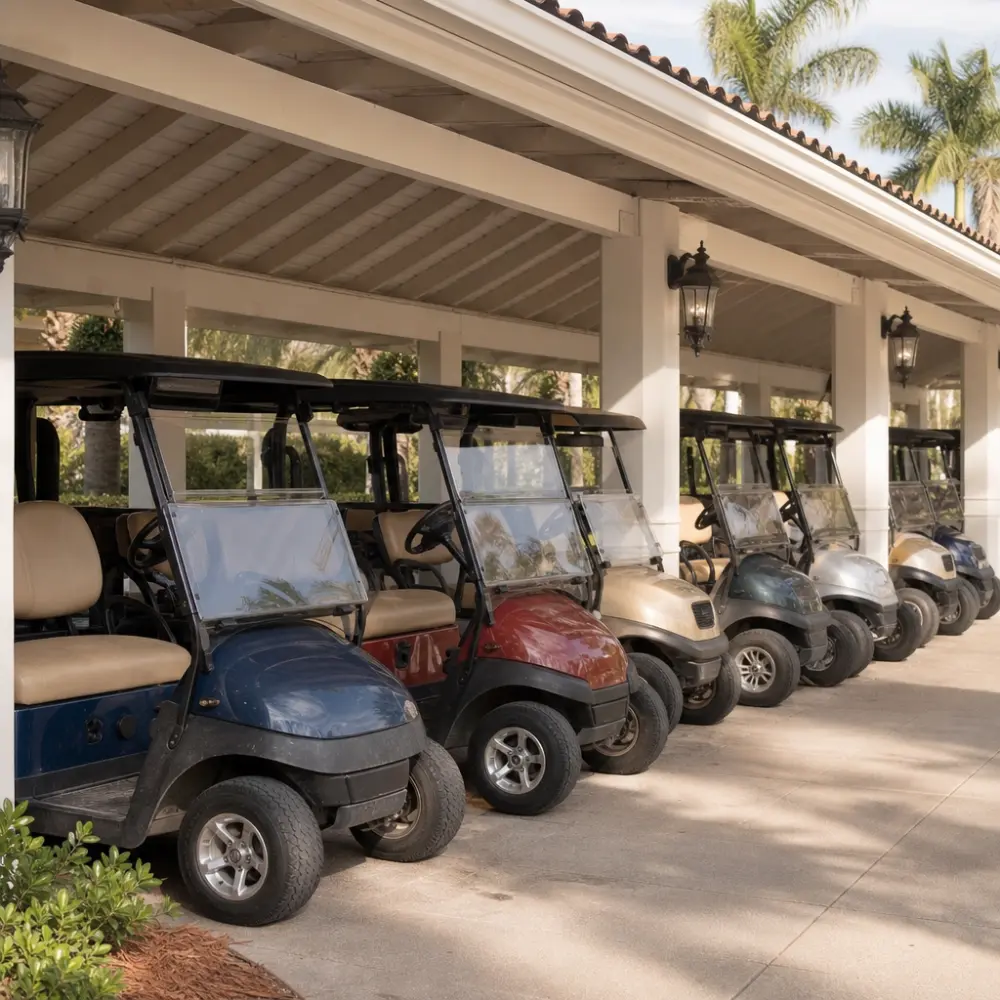
Brake and tire service happens right in the driveway anywhere across Lakeland and the surrounding Polk County towns: adjustment about $75, shoes and drums $100 to $250, a full overhaul $200 to $400, tires $75 to $150 each installed, with the $50 to $100 service call applied toward whichever job it is. These are the two fastest-wearing parts on any cart that earns its keep, and in this part of Florida, nearly every cart does.
Two local conditions that shorten their life
There is no off-season here to spread wear across. NOAA’s normals put the December low around 54°F, nobody is parking a cart away for winter, and a cart doing daily errands or daily laps of a course like Sanlan’s 27 holes off US 98 South racks up more stop-and-go cycles in a single year than the same cart would see over several years somewhere with real winters. Brake shoes and tires wear on cycle count, not the calendar, and the calendar never gives this area a break.
Humidity does the rest of the damage. Annual rainfall here runs 56.82 inches, with roughly 60 percent of it, about 34.24 inches, falling June through September. Brake cams and cable ends sitting through a wet summer oxidize and bind, which is why a cart that felt perfectly fine in May can be dragging a shoe by October. A cart stored outdoors sees that corrosion arrive noticeably faster than one kept in a dry garage.
The three levels of brake work
Most golf carts run mechanical drum brakes on the rear wheels, cable-actuated from the pedal, with a parking latch that holds the pedal down. Nearly every job fits one of three tiers:
| Job | What it involves | Price |
|---|---|---|
| Adjustment | Take up cable slack, center the shoes, verify the parking latch, blow out the drums | About $75 |
| Shoes and/or drums | New shoes, new drums if scored, hardware cleaned and lubricated | $100 to $250 |
| Full overhaul | Shoes, drums, cables, springs, cams, and pedal hardware together | $200 to $400 |
The diagnostic ahead of any of that starts with pedal travel, whether the cart holds on an incline with the parking brake set, whether braking pulls to one side, and a look inside the drums themselves. A seized cam or a stretched cable frequently produces the full “brakes are gone” complaint for a fraction of overhaul money, and the brakes squeal or will not hold page has a short version of that check you can run yourself first.
Newer ICON and Evolution carts, along with most low-speed vehicles, use hydraulic brakes and sometimes front discs rather than the mechanical drum setup above. Those get serviced too, with pad and rotor pricing quoted per cart since parts vary significantly by brand.
Tires: how they fail and what to put back on
Three failure modes account for almost every tire call here. Dry rot comes from heat and sun exposure, with 118.7 days a year at or above 90°F cracking sidewalls on any cart that spends time parked outside. Cupping and feathering comes from misalignment or a worn kingpin, showing up as a rhythmic thump while driving. Bald tread simply comes from year-round mileage on paved streets and golf course cart paths with no winter pause to slow it down. The tire flat or dry-rotted page walks through telling these apart.
| Tire | Price installed |
|---|---|
| Standard turf or street tire | $75 to $150 each |
| Full set of four, standard | $300 to $600 |
| Lifted or low-profile styles | More, quoted per cart |
Turf tires suit a course like Sanlan’s 27 holes, running soft, wide, and low pressure for the fairway. Street tires hold pressure better and wear longer on the pavement of Lakeland’s neighborhood streets. All-terrain tread for a lifted cart costs more and wears faster once it meets asphalt regularly. A cart that spends real time on a course does better on turf tread; one that never leaves the neighborhood does better on street tread. Either mounts in your driveway with wheels balanced and lug nuts properly torqued.
Tire pressure alone deserves its own mention: underinflated tires drag, and dragging tires mimic a tired battery pack closely enough to fool an owner. A pressure check is built into every tune-up, and it is the single cheapest range fix available.
Where the law lands on this
F.S. 316.212(6) requires “efficient brakes, reliable steering apparatus, safe tires, a rearview mirror, and red reflectorized warning devices” on a golf cart operated on any street a county or city has designated for cart use, and F.S. 316.2122(1)(b) separately requires parking brakes on a low-speed vehicle. Our search of the City of Lakeland’s and Polk County’s codes of ordinances found no street designated for carts, so in practice nearly every cart mile here happens on private property, where whatever rules the owner or association sets apply instead. That does not lower the stakes: a cart that cannot stop reliably is still a liability on private pavement, just one nobody from the city is checking. Full statute text lives on the street-legal rules page.
Combining the visit
The wheels are already off for a brake job, which makes tires on the same trip cheaper than a separate visit, and a tune-up tacked onto either costs less than booking it alone. Mention everything the cart needs when booking and it all lands on one estimate. The repair cost calculator prices any combination straight from the same list.
Booking the work
Share the cart’s brand, whether it is lifted, what the brakes are currently doing (squealing, grinding, rolling at a stop, pulling), and the tire size off the sidewall if it is legible. Shoes, drums, and the right tires come along on the first trip, finishing the job in one visit anywhere in Lakeland, Kathleen, Highland City, or Mulberry.
Frequently Asked Questions
How much does golf cart brake repair cost?
A brake adjustment runs about $75. New shoes and/or drums run $100 to $250. A full overhaul with shoes, drums, cables, and hardware runs $200 to $400. All installed in your driveway, with the $50 to $100 service call applied toward the work.
How much are golf cart tires installed?
$75 to $150 per tire installed, $300 to $600 for a set of four. Lifted carts and low-profile street styles cost more. The tires are brought to you and mounted on-site.
Why do my brakes squeal or grind?
Squeal is usually glazed shoes or grit packed into the drum. Grinding means the lining is gone and metal is on metal, which scores the drum and turns a $100 job into a $250 one. Carts that spend most of their time outside pick up more of it than carts kept in a closed garage.
Are brakes a legal requirement on a golf cart?
Yes. F.S. 316.212(6) requires efficient brakes on any golf cart operated on a designated street, and F.S. 316.2122 requires parking brakes on a low-speed vehicle. A cart that rolls at a stop is not just worn; it is out of compliance wherever the statute applies.