 Lakeland Golf Cart Repair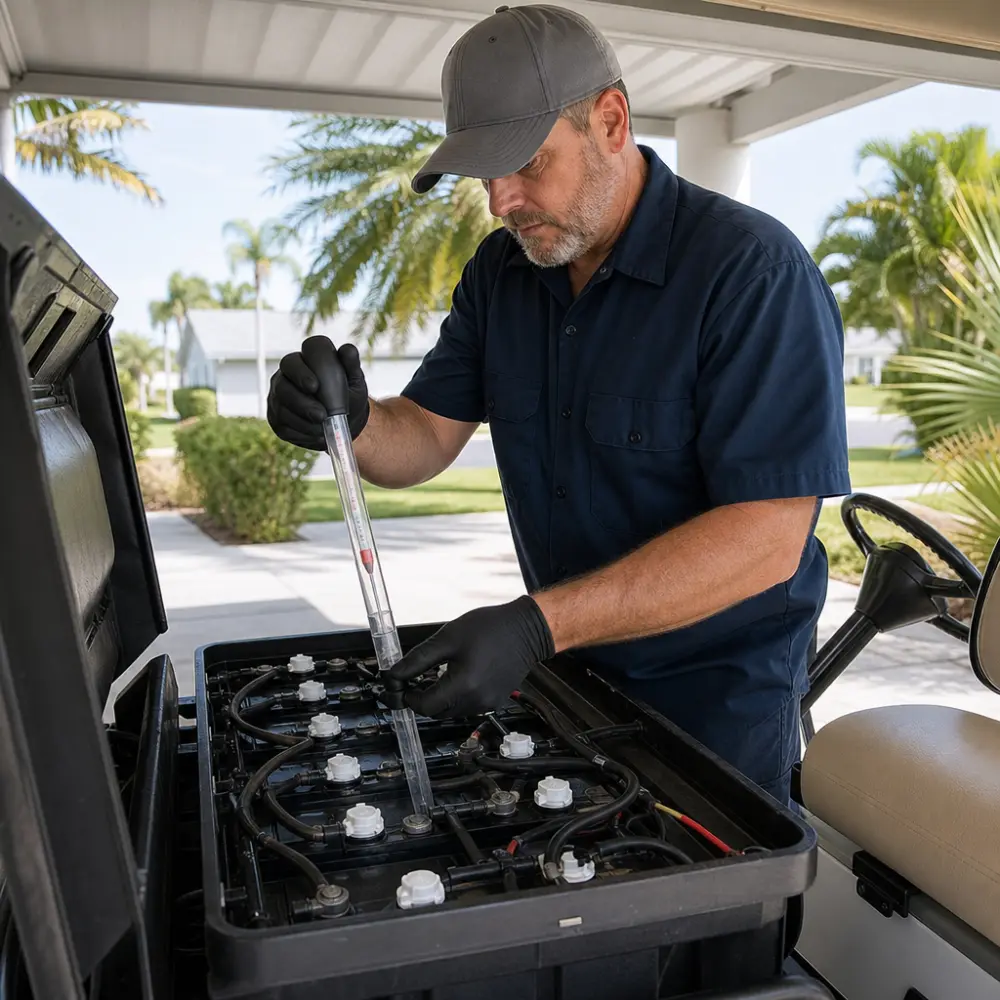
Lakeland Golf Cart Repair sends a technician to your driveway, garage, or cart barn anywhere in Lakeland and the surrounding Polk County towns and fixes your cart on-site: batteries, brakes, tires, chargers, solenoids, motors, controllers, and lights. A full lead-acid battery pack runs $1,200 to $1,800 installed, brake work $75 to $400, tires $75 to $150 each, and the $50 to $100 service call is applied toward your repair. Describe the symptom on the form so the technician can bring the likely parts on the first visit.
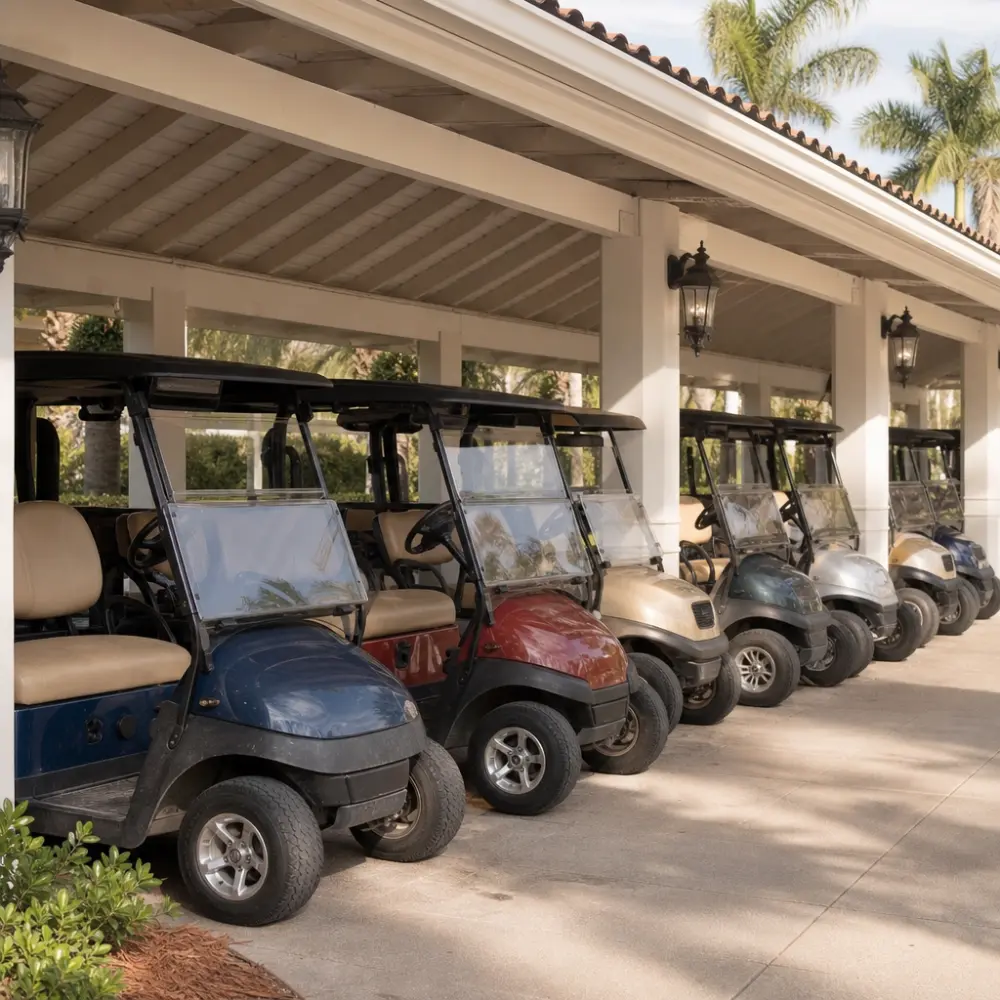
Golf carts around Lakeland are not a novelty. The city’s own Cleveland Heights Golf Course, marking its 100th year, traded its entire fleet of 100 carts to Club Car in early 2025 for a lithium-ion fleet under a five-year warranty, a straight acknowledgment from the people who run the fairways here that lithium has won the argument for carts that work every day. Downtown, a free shuttle called The Squeeze has carried riders on eight-passenger golf carts around downtown since November 2021, and Dixieland residents asked in 2025 for it to be extended into their neighborhood. None of that is a sign of a cart culture confined to a golf course. It is daily transportation that happens to run on batteries, and when it breaks, the fix has to come to the driveway.
What we fix, at your home
- Mobile golf cart repair: the core service. On-site diagnosis and repair of whatever is wrong: will not move, will not charge, weak on a hot afternoon, clicking, cutting out. All major brands, electric and gas.
- Battery replacement: new lead-acid packs installed with haul-away of the old cores, plus honest lead-acid versus lithium math for carts that run every day of the year.
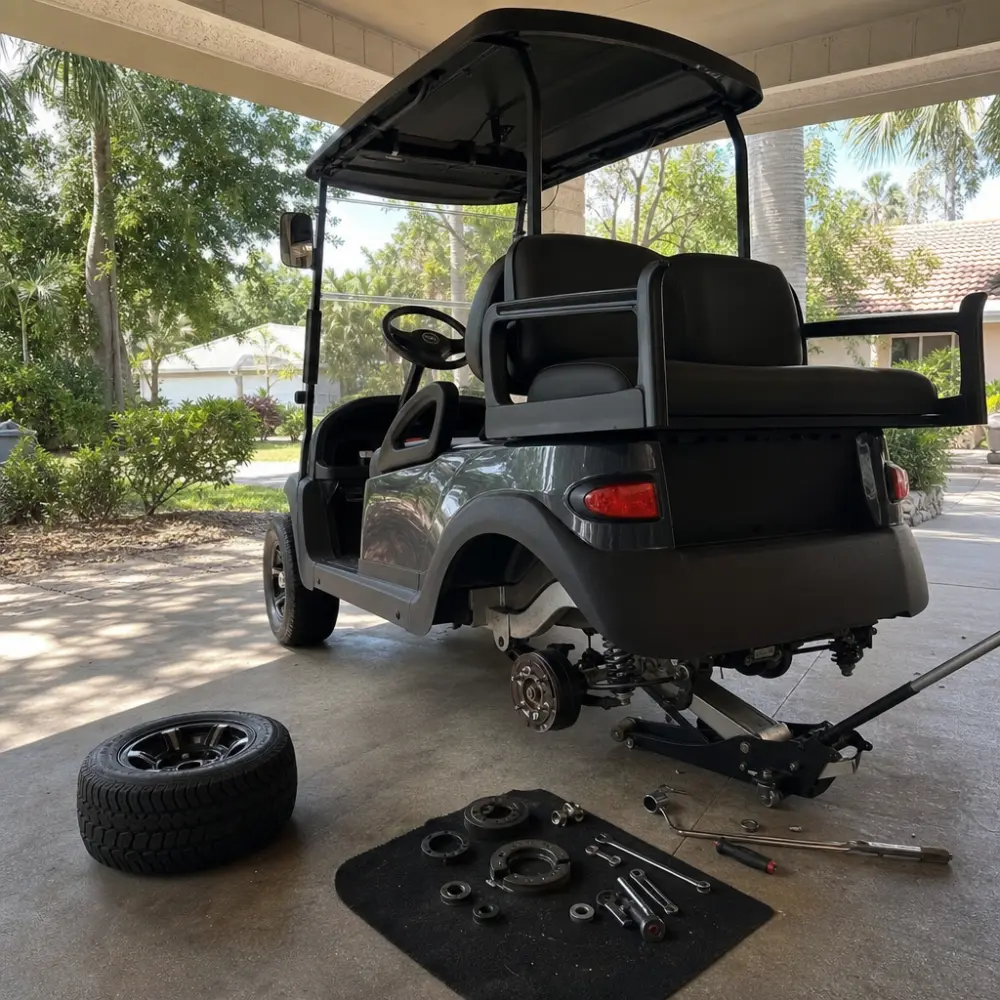
- Brakes and tires: adjustments, shoes, drums, and new tires installed in your driveway.
- Motor and controller repair: solenoids, speed controllers, and drive motors diagnosed with meters before anything gets replaced.
- Charger repair: carts that “will not take a charge” are often a charger, charge port, or corroded connection, not a battery problem. We test before we sell you anything.
- Tune-up service: the annual that keeps a pack and a brake set ahead of a Central Florida summer: battery water and load test, terminal cleaning, brakes, tires, lights, and a corrosion check.
- Lights and street-legal equipment: headlights, brake lights, signals, mirrors, and reflectors installed to what F.S. 316.212 actually requires.
Full ranges for everything are published on the pricing page. Competitors make you call for a number. We would rather you see it first.
Why Lakeland carts break the way they do
Heat is the battery killer, and Lakeland runs hot even by Florida standards. NOAA’s 1991 to 2020 climate normals for the Lakeland 2 station put the July average high at 92.1°F and August at 92.2°F, and count 118.7 days a year at 90°F or above, nearly a third of the calendar. Inside a flooded lead-acid battery, heat evaporates water out of the electrolyte faster, and once the level drops below the top of the plates the exposed lead sulfates and permanently loses capacity. Heat also raises self-discharge, so a cart that sits two weeks in a closed garage in July comes back lower than it left. A pack rated for five or six years of northern golf-course duty often taps out at three or four here. Watering on a schedule from May through September is the cheapest thing you can do for a $1,200 pack.
The wet season does not let anything dry. NOAA’s normals put Lakeland’s annual precipitation at 56.82 inches, and the four months of June through September alone account for 34.24 inches of it, roughly 60 percent of the year’s total. Garages stay damp through that stretch. Terminals, cable lugs, and charge-port contacts oxidize, corroded connections add resistance, resistance mimics a dying battery pack, and owners end up shopping for $1,200 in batteries when the real fix is a $100 cable-and-terminal service. Part of every diagnostic is a voltage-drop check along the main cables.
Storm season changes the job. Hurricane Milton passed close enough in October 2024 to drop 13.13 inches of rain at Lakeland’s own airport, KLAL, with the storm’s minimum pressure reading of 975.5 millibars recorded there. Ahead of forecast weather we prioritize charger and battery calls, because a fully charged cart matters most when the power goes out. Afterward comes the other side: chargers that took a surge when the power came back, and packs that were left sitting at partial charge through the outage.
Carts also go missing, and it is worth planning for. The Polk County Sheriff’s Office has logged golf cart thefts in the Lakeland area, including a cluster in late 2021 when at least six carts were taken from addresses in one Lakeland neighborhood over about six weeks. The advice from those releases is simple and cheap: take the key out, add a locked chain, and consider a GPS tracker or an AirTag in the battery bay. None of it is a repair, but it is worth doing before a dead battery is the least of your problems.
Golf cart or LSV: the 20 mph line
Florida Statute 320.01(22) defines a golf cart as a vehicle built for a golf course that is “not capable of exceeding speeds of 20 miles per hour,” and 320.01(41) defines a low-speed vehicle as a four-wheeled vehicle whose top speed is “greater than 20 miles per hour but not greater than 25 miles per hour.” That number decides your rulebook.
A golf cart under F.S. 316.212 may be driven only on county roads or municipal streets that the county or city has designated for carts, sunrise to sunset unless the local government allows night driving and the cart has headlights, brake lights, turn signals, and a windshield. It must carry efficient brakes, reliable steering, safe tires, a rearview mirror, and red reflectors front and rear. As of October 1, 2023, a driver under 18 needs a learner’s permit or driver license; a driver 18 or older must carry valid government-issued photo identification.
We searched the City of Lakeland’s Code of Ordinances and Land Development Code, and Polk County’s Code of Ordinances and Land Development Code, for a golf cart street designation and found none as of this writing. Until one exists, a sub-20-mph cart in Lakeland stays on private property and community roads, where the property owner or association sets the rules. The one public exception is downtown’s free Squeeze shuttle, which has run eight-passenger carts around downtown since November 2021; we have not been able to confirm the legal basis for that route, so we do not characterize it as evidence of a designated public street.
A low-speed vehicle under F.S. 316.2122 is a titled, registered, insured motor vehicle allowed on any street posted 35 mph or less, with headlamps, stop lamps, turn signals, taillamps, reflectors, parking brake, mirrors, windshield, seat belts, and a VIN required, and it must also meet the federal low-speed vehicle safety standard, 49 CFR 571.500. Plenty of ICON and Evolution carts sold here are LSVs from the factory. On those, brake and lighting work is required equipment, and we treat it that way. The whole map, with the statute sections, is on our street-legal rules page.
Where the carts live
Several golf course communities sit inside and around Lakeland. Sanlan RV & Golf Resort, off US 98 South, spans roughly 785 acres and is the one local community whose own materials actively promote golf cart use, offering rentals for guests who do not bring their own alongside a private entrance to the adjoining 27-hole Sanlan Golf course. Cypress Lakes Village, on US 98 North, is a 55-plus community built around the 36 holes of Big Cypress Golf Club, with a November-through-April golf season. Schalamar Creek, on US 92 East, sits on 500 waterway-laced acres around its own 18-hole course behind a gated, tree-lined entrance. Highland Fairways, off Highland Fairways Boulevard in north Lakeland, is a gated 55-plus community built around a private 18-hole executive course. None of their own materials confirm golf cart rules for internal streets beyond Sanlan, so for the other three we describe them as golf course communities rather than claim cart traffic on their roads.
Beyond city limits, we also run calls out to Kathleen to the northwest, Highland City to the southeast, Mulberry to the south, Polk City to the northeast, and Plant City over the county line to the west.
How a mobile visit works
- Tell us the symptom. Will not move, clicks but no go, will not charge, sags on a hot afternoon, squeals when braking. Most problems narrow down fast from a good description, so the tech arrives with the likely parts.
- We come to you. Driveway, garage, or cart barn, at a scheduled window. The $50 to $100 trip fee includes the diagnostic and gets applied to the repair.
- We diagnose before we recommend. Load test on each battery, voltage checks across the pack, charger output test, voltage drop along the main cables, solenoid and controller checks. We isolate the actual fault instead of selling the most expensive maybe.
- Flat quote on the spot, fix on the spot. Mobile technicians commonly carry battery sets, solenoids, brake shoes, and tires. Approve the number and most jobs are done in that same visit.
- Finish clean. Lead-acid packs get watered and terminals cleaned and coated, everything gets a torque check and a test drive, and old batteries leave with us for recycling.
Straight answers, published prices
Two things we will not do. We will not pretend to be something we are not: we are an independent service, not an authorized dealer or warranty center for Club Car, E-Z-GO, Yamaha, ICON, or Evolution. If your cart is under factory warranty, your selling dealer should handle warranty work. And we will not sell parts you do not need. A cart that will not charge gets a charger and charge-port test before anyone talks about a battery pack, and a weak cart gets a per-battery load test before we condemn six batteries when one is the problem. If a repair does not make sense against the value of an old cart, we will say that too.
The work is arranged with local golf cart technicians. More on how we operate is on the about page, and the FAQ answers the most common owner questions.
Get a fast quote
A cart that will not leave the garage is the reason a mobile service exists. To get the right parts on the first visit, tell us the brand, model year if you know it, whether it is a 36V or 48V electric or a gas cart, and what it is doing. A photo of the battery compartment or dash helps. We will come back fast with a flat number and a scheduling window, and in most cases we can reach you same-day or next-day anywhere from downtown Lakeland to Highland City to Kathleen.